THE PAPER
Joseph Hecht paid particular attention to the paper he used. He often sourced antique papers from 18th-century registers, particularly laid paper (which, when held to the light, reveals fine horizontal parallel lines within its thickness), or sometimes made his own paper in his workshop.
For the publication of his albums, the paper was specially handmade for him at the Montval workshop in Viladon-le-Bon, directed by Gaspard Maillol. This paper bore the watermarks of Joseph’s pike fish crest and Maillol’s coat of arms. It was never pure white but slightly tinted with warm colors, such as jade green for the Animaux edition.
He rarely used Chinese or Japanese paper, which he felt « lacked the strength required to convey the spirit of European copper engraving, despite being among the strongest papers in the world. »
He occasionally used parchment and, very rarely, leather or vellum. For états (trial proofs), he used whatever paper he had available in his workshop.
In his « Essay on the Technique of Burin Engraving, » Joseph stated:
« In the past, men of genius, in their pursuit of Great Art, neglected no aspect of the creation of a work of art. »
THE INK
He composed and ground his own ink.
« Burin engravings are printed in black ink or as follows: one-third candle black and two-thirds German black, ground together with linseed oil, to which a modest amount of strong oil is added. Once well ground on your slab, sprinkle the ink with a little yellow lacquer—darker than a lemon but lighter than an orange. After grinding these three colors, add carmine, the finest you can find. Inks ground by hand are always better than those ground by machine—I don’t know why. Perhaps a few drops of sweat falling from your brow during grinding, or the ash from a cigarette falling into the color. The ink must remain firm. »
PRINT RUNS
Some print runs are uncertain, undetermined, or even unlikely. There is very little information on this subject.
SIGNATURES
Generally, all prints, including états, were signed by Joseph. Early in his career, he signed in ink, later switching to pencil, usually in the lower right corner.
After his death, unsigned prints found in his workshop were stamped with the studio’s mark, including some printed on contemporary paper.
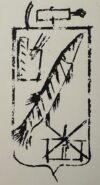
From 1927 (with the engraving of the « Bison »), most plates, in addition to the signature, featured a crest designed by the artist symbolizing his activities and name:
- The pike fish (Hecht in German)
- The painter’s palette in the upper left corner
- The printmaker’s press in the lower right corner (or vice versa)
- Sometimes supporting the engraver’s chisel
TITLES OF THE ENGRAVINGS
Most titles were given by Joseph Hecht. Some were transcribed by his second wife, Anna Bilde, who compiled the first list of his engravings in 1951. Others were assigned by the curators of the 1992 Gravelines exhibition, with the approval of his son Henri. This explains some errors noted by the organizers of the 2024 exhibition, who consulted animal specialists (e.g., a misidentified crow).
DATING OF THE ENGRAVINGS
In the absence of precise dating, some dates must be approached with caution, as Joseph was full of surprises. He sometimes revisited old subjects later, adapting them to a new style.
For example, the mountain « Skaugumäsen », first engraved in Norway in 1916, reappears in « The Great Quarry » (1935) or « Fierce Battle » (1937), not to mention his paintings.